

Application-Layer (L7) DDoS Defense In Depth Explained
Application-layer (L7) DDoS defense operates as a defense-in-depth stack. Incoming HTTP/HTTPS requests (the focus here) are filtered progressively from the internet edge inward until only valid traffic reaches the origin application servers. This ordered, multi-layer approach minimizes resource consumption at each stage and allows early dropping of malicious or suspicious traffic.
The sequence below reflects the usual real-world processing order in modern web architectures (cloud-native, hybrid, or on-prem with edge services). Many organizations collapse layers (e.g., a CDN that bundles edge filtering + WAF + bot management), but the logical flow remains the same. I focus exclusively on application-layer techniques—no network/volumetric (L3/L4) elements like SYN floods or UDP amplification.
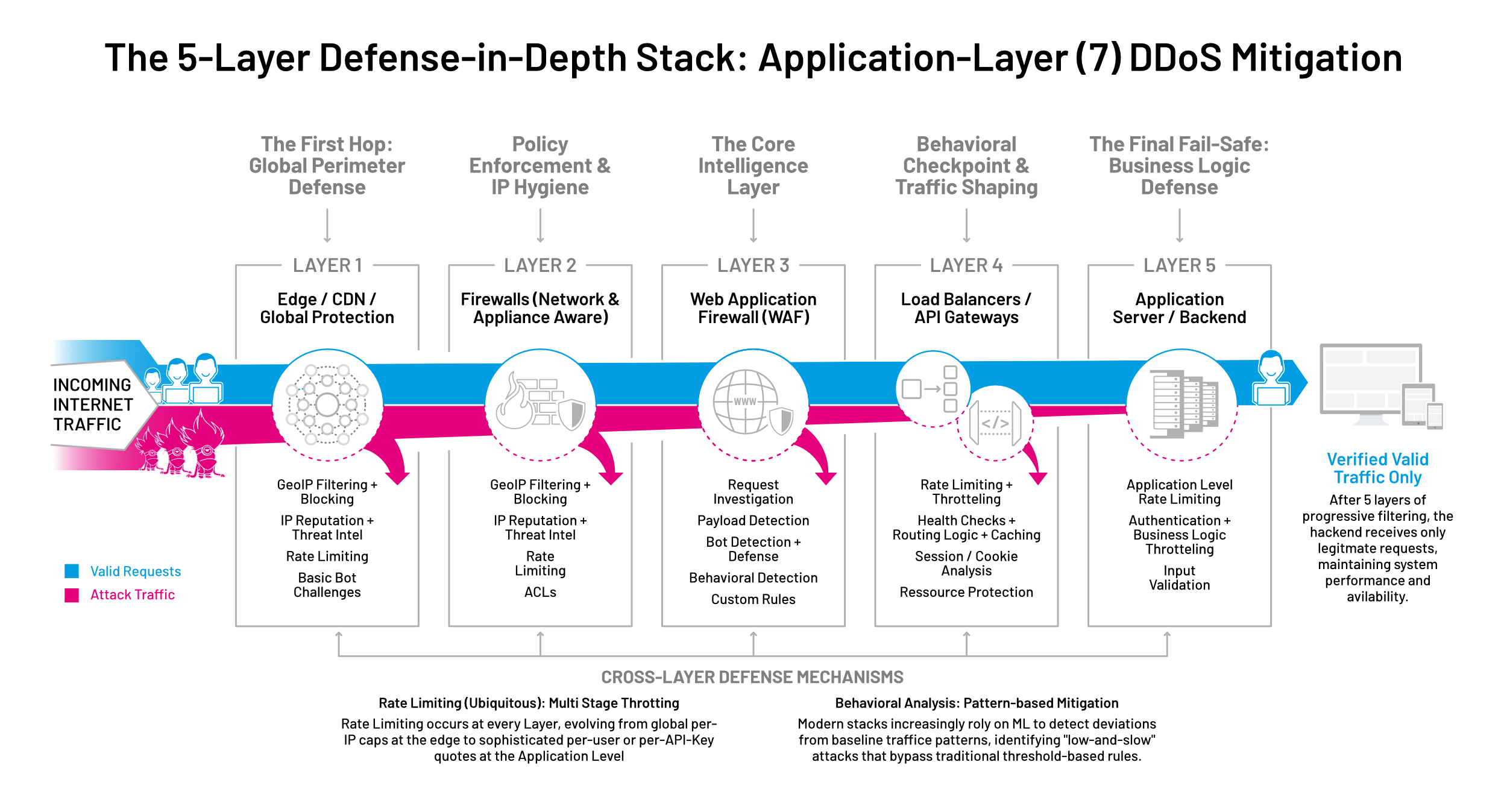
The 5-Layer Defense-in-Depth Stack: Application-Layer (L7) DDoS Mitigation
1. Edge / CDN / Global DDoS Protection Services (First Hop)
Managed/Manual Testing with a 3rd party
This is the outermost layer. Traffic hits anycast DNS-resolved PoPs or cloud edge networks (e.g., Cloudflare, Akamai, Fastly, AWS CloudFront, Google Cloud Armor, Imperva, or Azure Front Door). CDNs are used mainly for cost reduction, not as a defense layer. They cache and deliver static resources (images, CSS, JS, fonts, video) from the edge to cut origin bandwidth and compute costs. Virtually all global enterprises and most banks already have them for exactly this economic reason.
Key defenses applied here:
- GeoIP filtering/blocking – Blocks or challenges entire countries/regions based on IP geolocation.
- IP reputation / threat intelligence – Blacklists or scores IPs known for abuse (from global sensor networks).
- Rate limiting (global or per-IP) – Enforces request-per-second or per-minute caps before deeper inspection.
- Basic bot detection and mitigation – JavaScript fingerprinting, browser challenges, or proof-of-work to weed out simple scripted bots.
- Lightweight L7 rules – Early anomaly detection or cached responses to reduce origin load.
Why first? It absorbs or drops traffic closest to the source, leveraging massive global scale and low latency. Most legitimate traffic passes through quickly; suspicious traffic is slowed or challenged here. Many providers auto-apply these via managed rules.
2. Firewalls (Cloud or On-Prem Network/Application-Aware Firewalls)
After the edge (or integrated if using a unified service), traffic reaches a firewall layer – e.g., AWS Network Firewall, Azure Firewall, Google Cloud Armor policies, or hardware like F5 AFM / Palo Alto.
Key defenses applied here (L7-capable variants):
GeoIP and IP-based controls – Refined blocking or allow-listing (more granular than edge-level).
Rate limiting – Additional per-IP or per-subnet throttling.
Basic access control lists (ACLs) – HTTP header or URI pattern matching (not full payload inspection yet).
Role: Acts as a policy enforcement point. It’s lighter than a full WAF but provides fast, stateful filtering. In many setups this layer is thin for pure L7 DDoS (it shines more on protocol-level threats), but it’s still common for geo/rate hygiene before expensive inspection.
3. Web Application Firewall (WAF)
This is the core intelligence layer for L7 DDoS. Traffic is routed through a dedicated or managed WAF (AWS WAF, Cloudflare WAF, ModSecurity, Imperva WAF, Fortra, etc.). It often sits right after the firewall or is integrated into the edge/CDN.
Key defenses applied here (deep HTTP inspection):
- Request investigation – Full parsing of method, URI, headers, query strings, cookies, and body.
- Payload detection and anomaly scoring – While primarily for exploits (SQLi/XSS), it also flags DDoS patterns like repetitive payloads or malformed requests.
- Rate-based rules – Counts requests over time windows (per IP, per session, per endpoint, or per custom attribute like user-agent + IP). Modern WAFs (e.g., AWS AntiDDoS AMR or Google Adaptive Protection) auto-scale thresholds.
- Bot detection – Advanced fingerprinting, behavioral scoring, reCAPTCHA integration, or ML models to distinguish humans/bots/good bots (search engines).
- IP reputation + custom rules – Dynamic blocking based on attack signals.
Why this order? WAFs are CPU-intensive (full request analysis), so they come after lighter edge/firewall filtering. They catch sophisticated L7 floods (HTTP GET/POST floods, login brute-force, API hammering) that mimic legitimate traffic. Many providers now include automatic L7 DDoS mitigation that dynamically adds rules during attacks.
4. Load Balancers / Reverse Proxies / API Gateways (L7 Load Balancing Layer)
Valid traffic proceeds to L7 load balancers or proxies (AWS ALB/NLB with WAF, NGINX, HAProxy, F5 BIG-IP, Kubernetes Ingress, or cloud API gateways like AWS API Gateway).
Key defenses applied here:
- Behavioral detection – Monitors request patterns, session behavior, latency spikes, or heavy URLs across backends. Some (e.g., F5 Behavioral DoS or advanced LB modules) use ML to detect anomalies like sudden surges in specific endpoints.
- Additional rate limiting / throttling – Per-backend or per-session limits; traffic shaping to protect downstream servers.
- Health checks and routing logic – Routes away from overloaded or unhealthy app instances.
- Session / cookie analysis – Ensures sticky sessions or validates tokens to prevent session-based abuse.
Role: Distributes clean traffic while adding a final “behavioral” checkpoint. It’s closer to the origin, so it has better visibility into application-specific patterns (e.g., “this endpoint is being hammered while others are idle”).
5. Application Server / Backend Defenses (Innermost Layer)
Only thoroughly vetted requests reach the actual application servers, containers, or serverless functions, DDoS-trafic should be scrubbed in defense-layers before.
Key defenses applied here (in code or middleware):
- Application-level rate limiting – Often implemented with Redis, in-memory stores, or frameworks (e.g., token bucket, leaky bucket algorithms per user, API key, or IP). More granular than upstream layers.
- Authentication / business-logic throttling – Login attempt limits, OTP rate limits, or per-user quotas.
- Custom bot / anomaly detection – Middleware that checks user-agent behavior, request timing, or JavaScript execution proofs.
- Resource protection – Timeouts, circuit breakers, or auto-scaling rules inside the app stack.
- Input validation and caching – Reduces processing load for repeated or suspicious requests.
Why last? These are the most application-specific (and expensive) checks. By the time traffic reaches here, the volume is already drastically reduced. They serve as the final “fail-safe” for attacks that slip through (e.g., very low-and-slow or highly distributed botnets).
Resources:
Avydos DDoS Threat Simulation and Automation Platform: https://avydos.com
zeroBS DDoS Testing Services: https://zero.bs
Infos & Contact
Cover Image: zeroBS
 English
  German