

DDoS Resilience Testing in 2026: When to Use Manual, Platform, or Automated Approaches
DDoS testing has come a long way over the past 10 years. As attack surfaces have expanded and attackers have become increasingly sophisticated, DDoS testing has evolved as well – as have the reasons why organizations want or need to conduct tests.
Today, companies have three main options for testing their DDoS defenses, each with different pros and cons in terms of realism, risk, effort, and cost: manual/managed testing with a 3rd party, selfservice/selftesting-platforms, and automated tests.
And since there is no longer a one-size-fits-all solution, we would like to explain the available testing options and which ones make the most sense in each scenario.
zeroBS covers all three bases: With our managed DDoS testing services and our self-service and automation platform, Avydos, we can provide a full range of services to meet our customers’ diverse needs. Links to our offerings are below under „References“.
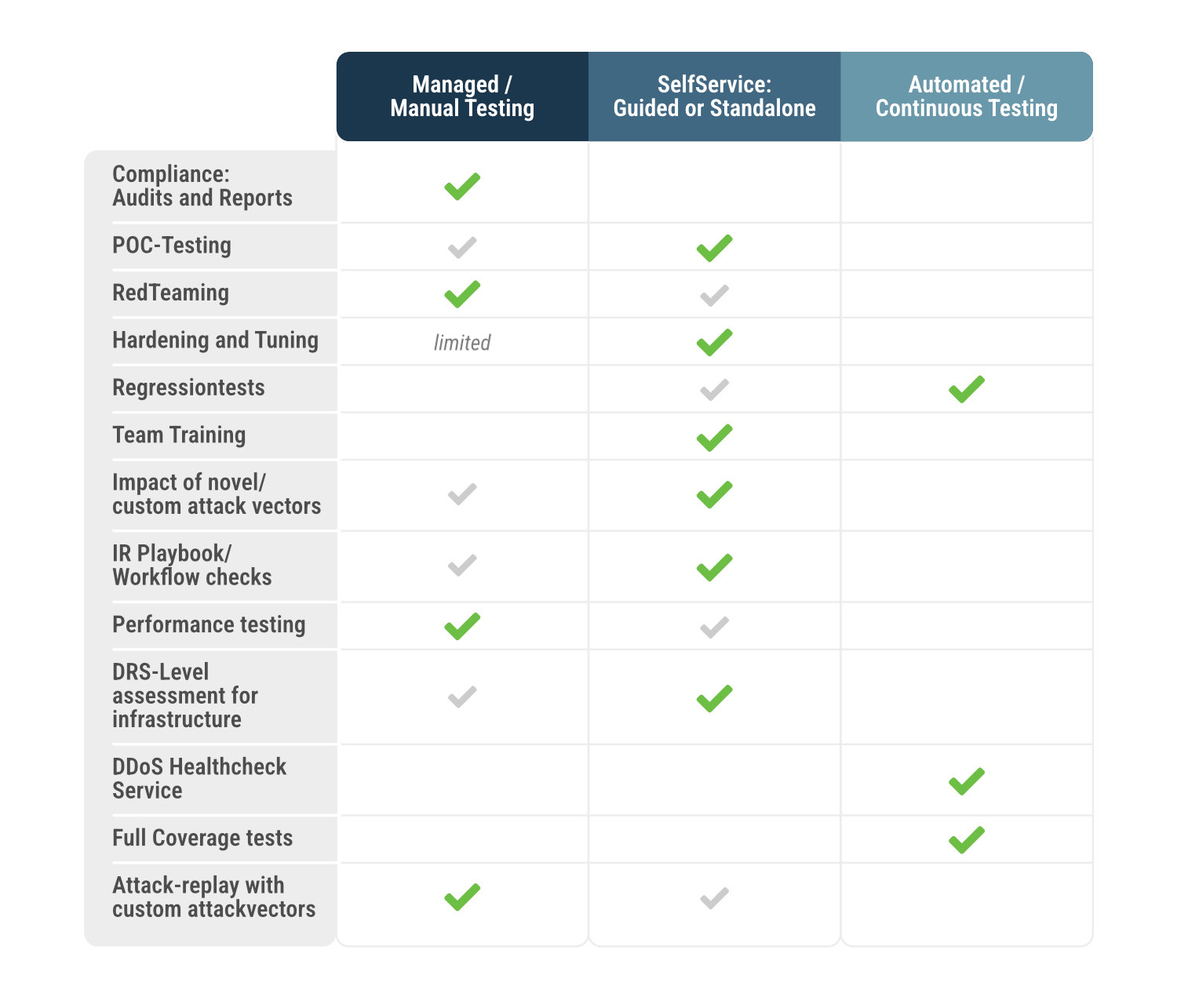
DDoS-Testing Options by zeroBS – based on Test Szenarios
Testing-Patterns explained
Compliance Tests: DDoS compliance tests are controlled simulations of DDoS attacks performed to demonstrate an organization’s resilience and meet regulatory requirements, particularly under frameworks such as DORA, NIS2, and TISAX.
POC-Tests: DDoS POC tests are real world attack simulations run against solutions from two or more vendors to compare their mitigation performance, detection accuracy, and overall effectiveness before selecting a DDoS protection provider.
DDoS-Redteaming: DDoS red teaming is an advanced offensive exercise in which specialists perform full infrastructure reconnaissance and craft targeted, individual attack patterns to realistically test an organization’s DDoS resilience and detection capabilities.
Hardening and Tuning: DDoS tuning tests are targeted simulations used to optimize mitigation rules, thresholds, and configurations, providing valuable insights that help security architects fine-tune and strengthen their DDoS defenses.
Regressiontests: DDoS regression tests are repeated attack simulations run after infrastructure changes, configuration updates, or deployments to verify that existing DDoS defenses still work effectively and no new vulnerabilities have been introduced.
Team Training/IR Playbook and Workflow checks: DDoS team training with real-world attack scenarios involves running controlled live simulations so teams can actively practice and validate their incident response workflows, playbooks, and detection capabilities under realistic DDoS conditions.
Performance Testing: combines DDoS attack simulation with load testing to measure how well interconnected systems maintain performance, availability, and response times when handling both malicious traffic and legitimate user load simultaneously.
DRS-Level Assessment: DRS (DDoS Resilience Score) assessment for infrastructure is a quantified rating that measures how well an organization’s systems can withstand, mitigate, and recover from DDoS attacks based on continuous testing and vulnerability analysis.
DDOS-Healthcheck: A DDoS healthcheck service is a continuous or periodic lightweight testing service that automatically verifies whether your existing DDoS defenses are still functioning correctly, properly configured, and capable of protecting your infrastructure against attacks.
Full Coverage Tests: A DDoS full coverage check is a comprehensive test that simulates all major attack vectors (volumetric, protocol, application-layer, and multi-vector) to validate that your defenses provide complete protection with no critical gaps.
Replay Tests: A DDoS attack replay is the process of re-executing previously captured or recorded real-world DDoS attacks against your infrastructure to test and validate how effectively your current defenses detect, mitigate, and recover from those specific attack patterns.
Testing Options Explained
Managed/Manual Testing with a 3rd party
Manual (or guided) DDoS testing involves human experts – typically specialized DDoS consultants – who actively design, execute, and adapt attack simulations against infrastructure and services.
This option is typically chosen when clients start with DDoS testing because the tests are conducted by experienced testers. Other very popular scenarios include mandatory compliance tests, POC-tests or DDoS-redteaming.
PROS: It comes as close as possible to a realistic simulation and real-world attack scenarios, and selecting experienced testers helps limit the damage caused by attacks.
CONS: Very costly and time-consuming due to the prescribed workflow involving scoping, paperwork, and playbooks and coordination between multiple stakeholders
Selfservice-Platforms like Avydos
DDoS platform testing refers to using specialized third-party platforms that allow organizations to simulate DDoS attacks on demand against their own infrastructure in a controlled and scalable way.
Choosing a self-service DDoS testing platform gives organizations greater speed, control, and flexibility compared to fully managed testing services.
Self-service platforms are particularly valuable for organizations that want to test more often, integrate testing into their operational rhythm, or build internal expertise.
PROS: Platforms enable faster testing cycles and allow for large-scale or multi-location-testing without the organizational overhead of manual testing. As a result, they are particularly cost-effective for teams whose needs go beyond a simple annual compliance test. Features such as AutoPilots and templates on the Avydos platform enable comprehensive regression testing without wasting significant resources.
CONS: Companies need to build up internal expertise and specialists to understand which targets can be attacked and through which attack vectors. This problem can be solved by including an embedded DDoS specialist who helps teams understand the DDoS threat and develop realistic test scenarios.
Automated/Continuous Testing
Automated DDoS testing uses tools to automatically generate and execute DDoS attack simulations with minimal ongoing human intervention. It focuses on speed, repeatability, and consistency, making it well-suited for regression validation, and establishing baseline resilience after infrastructure changes. However, it typically offers less customization and sophistication than manual or advanced platform-based testing, as it usually relies on predefined attack patterns rather than novel or highly tailored scenarios. This approach works best when organizations need regular, low-touch validation rather than deep, one-off assessments.
PROS: Due to its nature, continuous testing can identify issues and misconfiguration in an early stage and is excellent for unattended regression testing
CONS: Automated testing is only suitable for thorough validation to a very limited extent and is not flexible enough for the large-scale testing that system architects often need to establish baseline values. This leads to blind spots and carries the risk of a false sense of security.
Resources:
Avydos DDoS Threat Simulation and Automation Platform: https://avydos.com
zeroBS DDoS Testing Services: https://zero.bs
Infos & Contact
Cover Image: zeroBS
 English
  German